Starting a WISP in 2026 – Step 1: Market Research
This is step 1 of our guide to starting a WISP in 2026. The first step is market research. The competition has changed a lot since we first wrote this guide in 2013, and before you buy a single radio it’s important to make sure there’s a market for you to reach in the first place.
Starlink
You can’t get away from Starlink. It’s available everywhere, it has more brand awareness than any WISP will ever have, and in most places it can beat you on peak speeds. Not always though. A well-built sector with a clear line of sight will outrun a busy Starlink cell, and their speeds move around a lot depending on how many of your neighbours are on the same beam. In the US the residential plans currently run from about $55 to $130 USD a month depending on the speed tier (roughly $75 to $150 CAD in Canada), and the pricing changes fairly often.
The subscribers most likely to go with them are the power users, the ones who want the fastest plan available and will pay $100 a month or more for it. Those tend to be the same subscribers who use far more than the average amount of bandwidth though, the ones with BitTorrent running all day, and on a wireless network they can easily cost you more than they pay you. So rather than treating Starlink as impossible to compete with, it’s better to just let them have those customers and build a network for everyone else.
Fibre to the home
This one is the bigger issue, because on a purely technical basis you can’t compete with it. GPON fibre gives customers multi-gigabit service at prices about the same as what you’d be charging, with lower latency, lower maintenance costs, and huge economies of scale.
If you’re in a market where fibre is already deployed, don’t try to compete with it using wireless. If you still want to be an ISP there, the better route is to resell that fibre. In Canada this is fairly practical now. Since February 2025 the CRTC has required Bell, Telus and SaskTel to sell wholesale access to their fibre-to-the-home networks across their territories (the cable companies have had to sell third-party access for years), and the final wholesale rates were set in April 2026, so a small ISP can sign up as a wholesale customer and sell its own service over their fibre. In the US there’s no national rule like that. Reselling mostly happens on open-access networks, which are usually municipal or utility built (UTOPIA Fiber in Utah is the largest, with over a dozen retail ISPs selling on it), or through a regional carrier or electric co-op that will lease you capacity.
If you’re in a market that doesn’t have fibre yet, but has enough density of homes and businesses for fibre to make sense, consider being the fibre provider yourself. This costs a lot more than starting a WISP, but there are government programs that help pay for it. In the US that’s BEAD, the $42.45 billion program the NTIA runs through the states (every state’s plan was approved by August 2026 and the states are now handing out the awards, about 63% of them to fibre), along with USDA’s ReConnect loans and grants. In Canada it’s the $3.225 billion Universal Broadband Fund, which covers up to 90% of eligible costs, alongside the provincial programs and the CRTC’s Broadband Fund. A lot of that money is already committed, so the first job is finding out what’s still open in your state or province. How to navigate all of that is another article though. If your market has the density for cable internet but doesn’t have fibre yet, treat it the same way.
Low density and high obstructions
So you’ve found an area with a lot of unserved or underserved homes, but it’s still low density enough that it’s unlikely to ever be economical for someone to reach them with fibre. That’s a great WISP market!
Not all of these are created equal though. One drawback of WISP gear is that you need line of sight between each access point and each customer’s radio. Some markets, like the prairies or high desert, have almost nothing in the way, and a single tower can reach for miles all around. Thick forest and mountains can be very difficult to get good coverage in. It isn’t impossible, and sometimes just being the first to try means you get a new market all to yourself, but this is one challenge that can be expensive to overcome. In the past, some WISPs would put up a very tall mast at each subscriber, or partner with a tower company to install a small tower at the customer’s place to get over the trees, and then amortize the cost over a contract term. In the age of Starlink, which points straight up and doesn’t care much about obstructions, that isn’t a justifiable cost anymore.
What about non-line-of-sight gear? It’s true that equipment below 5 GHz (2.4 GHz or 900 MHz) can operate with some obstructions in the way, but it often can’t do so reliably. Those bands are very congested (basically every consumer wireless product is 2.4 GHz), and they have so little bandwidth that you wouldn’t be able to offer customers more than maybe 5 Mbit service, which was barely acceptable 20 years ago, let alone now.
Other WISPs
Okay, so you’ve got low density to avoid fibre, and low obstructions so you can reach your customers. The next thing to check is whether there’s already another WISP operating where you are. If there isn’t, you’re very lucky, because you’ve got all the unlicensed spectrum to yourself and you’ll have a much easier time of it.
If there is, you still might have a good shot, and it isn’t necessarily disqualifying. Check their reviews. A lot of WISPs got their start decades ago and haven’t put the investment into infrastructure upgrades that they should have, or they got acquired by a larger WISP that has largely abandoned the network. If their customers are unhappy with what they’re getting, you might be able to come in and do it right.
Working alongside an existing WISP means you’ll run into more contention for unlicensed spectrum, but with licensed backhauls, 6 GHz multipoint (with AFC), and 24 and 60 GHz links, there’s a lot of room to compete nowadays.
What about the cell companies?
They’re a bigger factor than they used to be. The cell carriers own large blocks of licensed spectrum, and their fixed wireless home internet (T-Mobile, Verizon and AT&T in the US, and the big three in Canada) has become the fastest growing kind of home internet in the US, with T-Mobile alone at around 7 million subscribers in 2026. The US plans are unlimited now, so the old advantage of them capping data at a few hundred gigabytes has mostly gone, though in Canada a lot of the plans still come with a monthly allowance before they slow you down.
In practice it’s still less of a problem in rural areas than those numbers suggest. They sell it as spare capacity on their cell towers, so at a lot of rural addresses it simply isn’t offered, and where it is, the speeds depend on how busy that tower is. The receiver is an indoor unit that sits by a window, which limits the range out from the tower, so their coverage is strongest close to their towers, at the edges of towns and along highways, and it thins out quickly in the low-density areas further out. The broadband maps below show licensed fixed wireless separately from unlicensed, so you can see exactly where they claim to reach.
How do I find all this out?
Helpfully, in both the US and Canada, ISPs have to file their coverage with the government, and it ends up on a national broadband availability map. In the US that’s the FCC National Broadband Map, and in Canada it’s the National Broadband Internet Service Availability Map from ISED. You can search any address or look at an area and see what competitors exist, what their coverage is, and whether they’re fibre, cable, DSL or wireless. Wireless is even broken down into unlicensed (usually other WISPs) and licensed (usually the cell companies). Take the wireless coverage with a grain of salt though, since it’s what the providers themselves claim, and a lot of WISPs draw their coverage polygons pretty generously.
To see what your own coverage might look like, there are tools with free tiers such as TowerCoverage and Cambium’s LINKPlanner for individual links, and the old free standby Radio Mobile is still around. Or use Swift Fox’s RF coverage tool to find the best tower sites in your area and see how many buildings each one could reach, which is included in the free trial and doesn’t need any equipment.
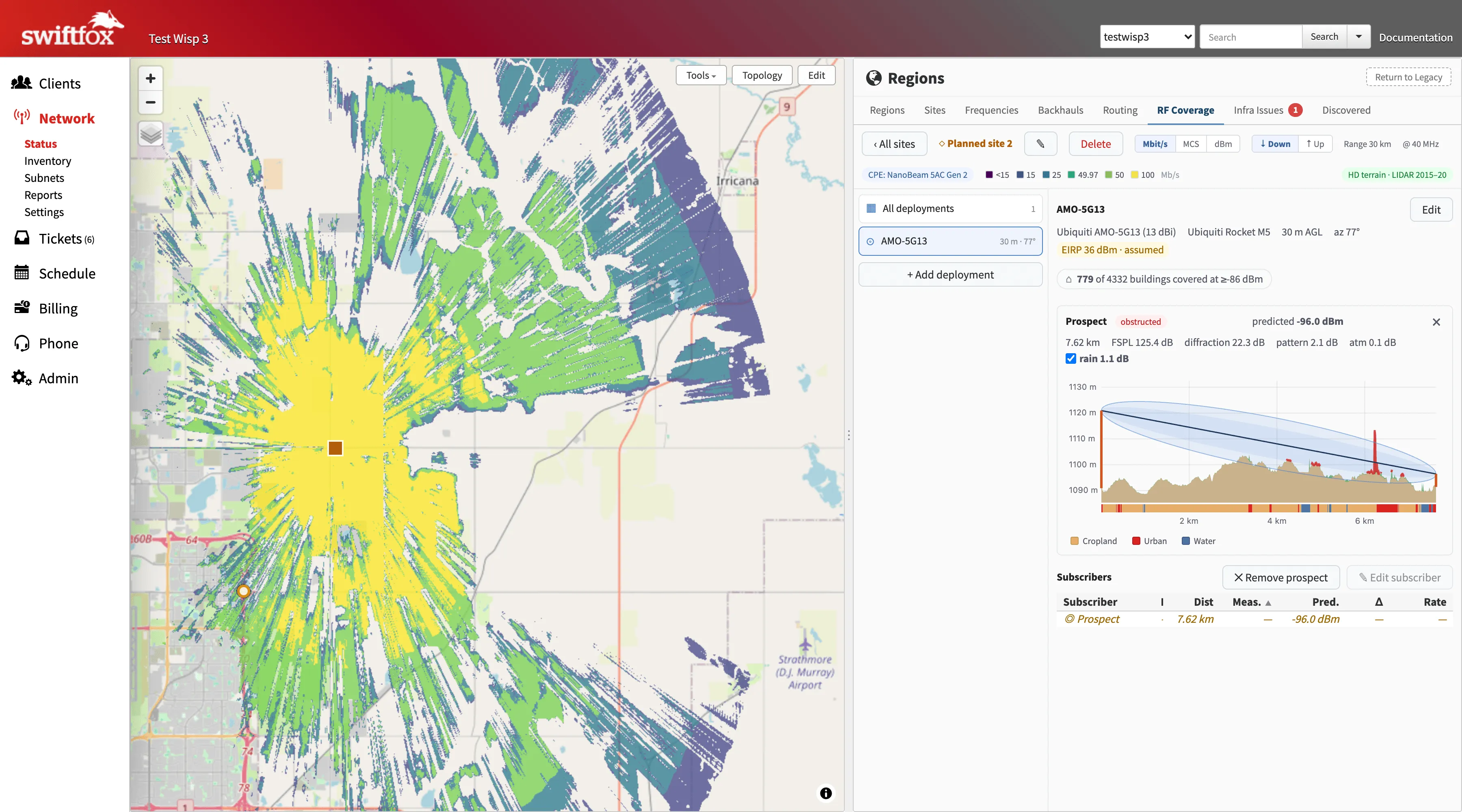
Swift Fox's RF coverage tool on a planned site. The sector's predicted coverage is drawn over the map from LIDAR terrain, with a count of the buildings it reaches, and a path plot out to one prospect showing the terrain and Fresnel zone along the way.
When it comes to where to put your access points, there are a few options:
- Build your own towers. This has the most flexibility, and generally means finding a hilltop somewhere with the best lines of sight and hiring a tower company to put one up for you. A guyed tower is cheaper and stronger than a self-supporting one, but takes up a lot more land. There’s also a lot of permitting to deal with, from the county or municipality, zoning rules, and FAA or NAV CANADA rules depending on the height.
- Lease space on existing towers. Companies like American Tower own towers all over the place and will lease you space on them, and the cell companies often lease space on theirs too. These generally cost more on a recurring basis, but can be cheaper and much faster to get started with. If the lease is priced per antenna, be mindful of how that cost will scale as you grow.
- Lease space on existing structures. Grain silos, water towers, tall buildings, whatever is around that has a great line of sight from the roofline alone. These are almost always the cheapest way to go, and you’re usually dealing with local businesses that are happy to work with other locals. You’re limited to what’s already there though.
What next?
If you’ve found a market and you think you can cover it, the next step is finding wholesale internet to feed it. The 2026 version of that step is next in the guide, and until it’s up, our 2014 article on wholesale internet access still covers the basics of what to ask for. If you’re working through this and want a second opinion on a market, we’d be happy to take a look at it with you!